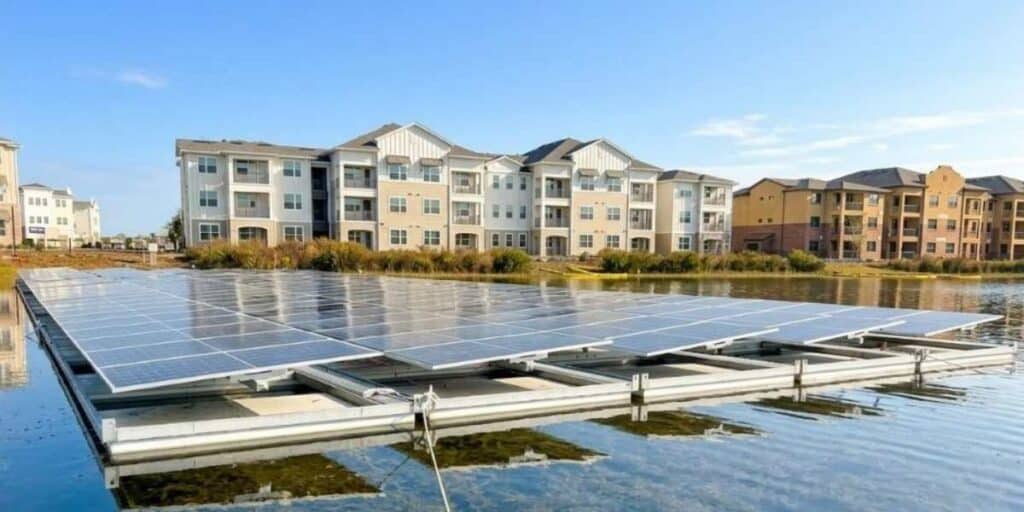
The floating solar industry has made tremendous progress over the past decade. Innovations in float design, anchoring systems, and photovoltaic performance are driving broader adoption across the globe. While much of the conversation has historically focused on cooler module temperatures, reflected sunlight from the water surfaces, and improved platform engineering, the industry’s next major advancement lies in floating solar tracking systems.
Unlike many performance enhancements that vary wildly based on local climate, water conditions, or project location, tracking offers a measurable and predictable increase in energy production. That level of certainty is becoming increasingly valuable for developers, investors, lenders, and independent engineers who need reliable production estimates before construction even begins.
Why Predictable Energy Gains Matter
The floating solar industry has spent years studying how environmental factors like cooler operating temperatures, reflected sunlight (albedo), and improved platform designs affect energy production. These advantages are real, but their impact depends heavily on site-specific conditions such as local climate, water quality, wind patterns, and system layout. Daily tracking is different.
Tracking systems actively follow the sun throughout the day, allowing solar panels to capture sunlight at optimal angles for much longer periods. Because this technology has been extensively studied in land-based solar applications, expected performance improvements can be accurately modeled before installation and verified after commissioning.
This level of certainty provides significant advantages for:
- Developers evaluating project returns
- Independent engineers validating system performance
- Financial institutions assessing project risk
- Owners seeking reliable long-term energy production
When projected energy output closely matches actual production, financing becomes more straightforward, and investment confidence increases. As a result, floating solar tracking systems are becoming an increasingly attractive option for developers seeking both higher performance and greater financial certainty.
Improving Project Economics
One of the primary goals of any renewable energy project is producing more electricity without proportionally increasing costs.
Infrastructure such as floats, anchoring systems, electrical equipment, and installation represent significant portions of a floating solar investment. By generating more electricity over the system’s lifetime, these fixed costs are spread across more kilowatt-hours.
This directly improves several key financial metrics, including:
- Higher annual energy production (AEP)
- Better return on investment (ROI)
- Improved project value
- Lower Levelized Cost of Energy (LCOE)
For project owners, increasing energy production from the same surface area means making every acre of water work harder without expanding the physical footprint of the project.
The Predictability of Tracking
Many emerging technologies promise incremental efficiency improvements, but daily tracking stands apart because its performance is highly measurable before construction even begins.
Decades of experience with solar tracker technology on land-based solar farms have created well-established performance models. Engineers can estimate production gains with a high level of confidence using historical weather data, solar resource modeling, and system simulations.
Rather than relying solely on environmental advantages that vary from site to site, developers can incorporate tracking into project designs with greater confidence in their expected energy gains. As floating solar projects continue to grow in scale and attract larger investments, this predictability becomes invaluable.
Two Directions the Industry Is Moving
As floating solar continues to mature, tracking systems are expected to evolve along two distinct paths.
Traditional Single-Axis Designs Adapted for Water
The first direction adapts proven single-axis trackers already widely used throughout the ground-mounted solar industry. This approach offers several distinct benefits:
- Well-understood engineering principles
- Proven mechanical reliability
- Quantifiable, well-documented energy gains
- Familiarity among developers, engineers, and lenders
- Established performance modeling techniques
Applying this proven design to water represents a natural evolution for projects seeking higher energy production while minimizing technological risk.
Rotating Entire Floating Arrays
The second approach is where floating solar becomes truly unique. Instead of moving individual rows of solar panels with traditional tracker mechanisms, engineers are designing systems that rotate the entire floating platform across the water’s surface.
Because the array floats, water naturally reduces the friction required for movement compared to rotating steel posts embedded in the ground. This opens the door for innovative system designs that simply aren’t possible on land. Potential advantages include:
- Lower resistance to mechanical movement
- Efficient use of natural buoyancy
- Simplified structural mechanics
- Improved tracking performance across large floating platforms
Although still in the earlier stages of commercial scaling, this concept highlights how floating solar has the potential not just to adopt existing technologies but to introduce entirely new engineering solutions.
Engineering Challenges Still Need Answers
Like every emerging technology, rotating floating arrays present important engineering questions that require continued research and real-world data. As floating solar tracking systems continue to evolve, ongoing testing and commercial deployments will help validate their long-term performance, reliability, and economic value.
Key considerations currently being optimized include:
- How continuous tracking affects anchor and mooring loads over time
- The long-term durability of mechanical drive mechanisms in wet environments
- Routine maintenance requirements in marine or freshwater ecosystems
- System reliability over a standard 25-to-30-year operational lifetime
- Structural performance during high wind events and changing water levels
As more commercial projects are deployed, these questions are being answered through rigorous field testing and operational data. This iterative process is exactly how nearly every major advancement in the solar industry matured from bifacial modules to ground-based single-axis tracking and large-scale battery storage.
The Future of Solar Tracker Technology on Water
The next chapter of floating solar is no longer focused solely on figuring out how to place panels on water. It is about maximizing the value and efficiency of every single floating project.
Cooling effects, reflected light, and advanced platform designs will always contribute to improved performance. However, daily tracking offers one of the industry’s most measurable opportunities for increasing annual energy production while drastically improving overall project economics.
As innovation continues, solar tracker technology is expected to play an increasingly important role in helping floating solar deliver higher energy yields without expanding project footprints.
With continued advancements in engineering, predictive modeling, and system durability, tracking may well become one of the defining technologies that shapes the next generation of floating photovoltaic systems.
The Next Evolution in Floating Solar
Floating solar has already demonstrated its unique ability to transform underutilized water bodies into valuable renewable energy assets. The next frontier is making those installations even more productive.
By combining durable floating infrastructure with intelligent tracking solutions, future projects can generate more electricity from the exact same surface area while improving long-term financial performance. As the industry continues to innovate, tracking systems have the potential to redefine what is possible for utility-scale floating solar establishing water-based photovoltaic generation as one of the highest-performing renewable energy solutions available.
If you’re planning a floating solar project or exploring innovative ways to maximize long-term energy production, AccuSolar can help. Contact us to learn how our engineering expertise and advanced floating solar solutions can support your project’s success from initial concept through final installation.