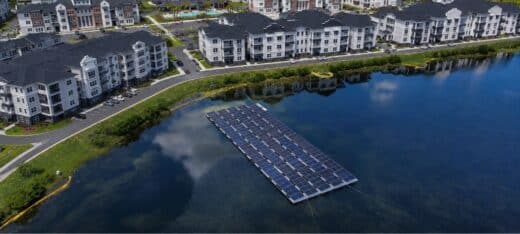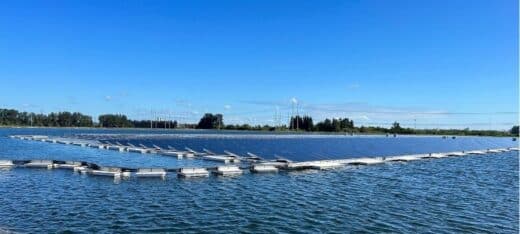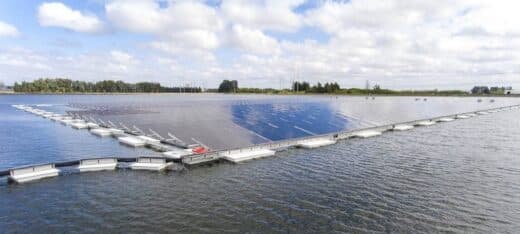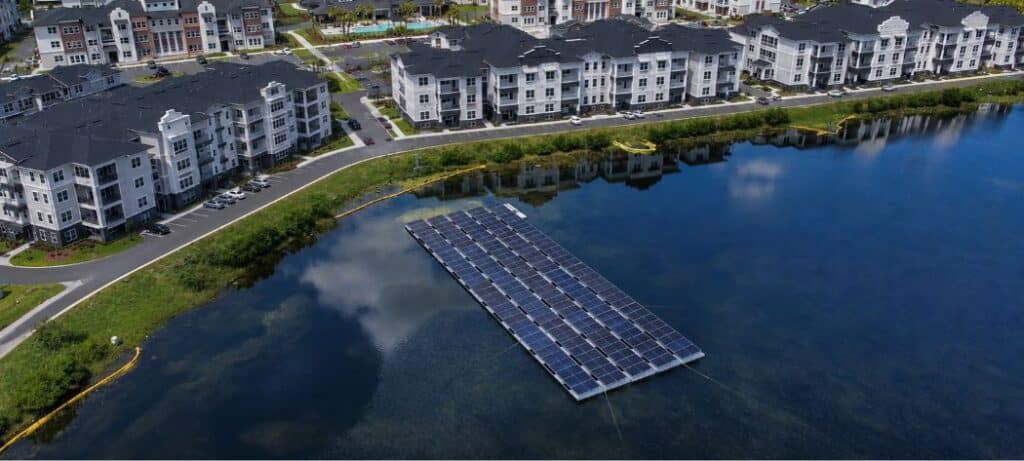
Determining the right size for a floating solar system starts with understanding both the available water surface and the energy goals of the project. While the acreage of a pond or reservoir helps establish how much solar capacity may physically fit, it is only one part of the sizing process.
Where the electricity will be used, local energy programs, interconnection opportunities, water body shape, shoreline conditions, regulations, and project type can all influence the final system capacity. A behind-the-meter installation serving an industrial facility, for example, may be sized around the facility’s electricity consumption, while a community solar or utility-scale project may be driven more heavily by available water area and program requirements.
As a general planning guideline, approximately two acres of water per megawatt (MW) of solar capacity can provide a useful starting point. However, every site is different, and detailed evaluation is necessary to determine how much of the available water surface can realistically support a floating solar installation.
Understanding these factors early in the development process can help determine whether a water body is suitable for floating solar and establish a realistic starting point for system capacity.
Understanding How the Generated Power Will Be Used
Before determining how many solar panels can fit on a pond, developers first need to understand how the electricity generated by the system will be used. In many cases, floating solar projects fall into two broad categories, behind-the-meter projects and front-of-the-meter projects.
A behind-the-meter project is generally designed to offset electricity consumed directly by a facility or business. This could include a manufacturing facility, wastewater treatment plant, industrial operation, data center, or another site with significant electricity demand.
For these projects, the facility’s electrical consumption is often the starting point for determining system capacity. A large water body does not necessarily mean that the owner should fill as much of it as possible with solar. Instead, the goal may be to develop a system appropriately matched to the facility’s electricity requirements.
Front-of-the-meter projects operate differently. Rather than primarily serving electricity demand at the site, the project may deliver electricity to the grid through a community solar program, utility agreement, feed-in tariff, or another applicable energy program. In these situations, available water surface area can become one of the primary factors affecting the potential project size.
Floating Solar System Sizing Starts With the Available Water Surface
Once the intended destination for the electricity has been identified, the next step in floating solar system sizing is determining whether the water body can accommodate the desired capacity. A useful early-stage guideline is approximately two acres of water surface for every 1 MW of floating solar capacity.
Using this general ratio, a 10-acre water body could potentially support consideration of a project around 5 MW. A 30-acre water body could provide enough space to begin evaluating a project around 15 MW. This is not a final engineering calculation. It is a preliminary screening tool that can help developers, utilities, municipalities, and property owners quickly determine whether a water body warrants further investigation.
Some floating solar technologies can achieve much greater density. Depending on system configuration and site conditions, a system may physically fit approximately 1 MW within as little as 1.3 acres. However, maximizing panel density is rarely the only consideration.
Additional space may be required for setbacks, shoreline access, anchoring and mooring infrastructure, maintenance, irregular pond geometry, environmental requirements, water-level changes, and other project-specific conditions. For that reason, the two-acre-per-megawatt guideline provides a practical starting point without assuming that every square foot of available water can or should be covered.
Why Total Pond Acreage Does Not Equal Usable Acreage
A 20-acre pond does not necessarily provide 20 acres of usable space for floating solar. Water bodies are rarely perfect rectangles. Many have narrow sections, curved shorelines, islands, inlets, infrastructure, vegetation, shallow areas, or other characteristics that reduce the amount of practical installation space.
Shoreline clearance also matters. Floating solar arrays typically need to maintain appropriate distances from banks and other site features. Space may also be needed to support installation, inspection, maintenance, anchoring, and electrical infrastructure. Local or project-specific requirements may further limit the percentage of a water body that can be covered.
This is why early calculations should be treated as screening estimates rather than final capacity numbers. Once a site appears viable, detailed engineering and site analysis can determine the actual usable surface area.
Behind-the-Meter Floating Solar Projects
For businesses and facilities with substantial electricity consumption, floating solar can be developed as a behind-the-meter energy solution. In this scenario, the electricity demand of the facility plays a major role in system sizing.
Consider an industrial facility with a large pond next to its operations. Even if the pond could physically accommodate a 10 MW array, that does not automatically mean a 10 MW project is the right choice. Developers must evaluate the facility’s energy consumption, load profile, available electrical infrastructure, and project objectives.
The desired system may be designed to offset a portion of annual electricity consumption rather than attempting to cover the maximum possible area of the water body. This approach can be particularly relevant for energy-intensive facilities such as manufacturing plants, water and wastewater facilities, industrial sites, and data centers. The water body establishes the physical ceiling for the project, while the site’s electricity requirements help establish the appropriate target.
Community Solar and Front-of-the-Meter Projects
When electricity demand at the property is not large enough to support a significant behind-the-meter installation, a front-of-the-meter project may be considered. Community solar programs are one potential option. Depending on the state and utility territory, community solar programs may establish specific project capacity limits and participation requirements.
Many community solar projects are developed at capacities up to approximately 5 MW, although applicable limits and program structures vary considerably by jurisdiction. Some locations may allow multiple projects associated with a larger site, while others may impose restrictions on how much capacity can be developed on a single water body or parcel.
Another important consideration is whether program limits are expressed in alternating current (AC) or direct current (DC) capacity. This distinction can influence the number of modules, inverter capacity, and overall project configuration. Before finalizing a floating solar array design, developers should therefore understand the specific requirements of the applicable state, utility, or regional program.
These regulatory details can change the amount of solar capacity that makes economic and technical sense for the site, even when the water body itself could physically accommodate a larger array.
What Size Water Body Is Needed for Community Solar?
Using the preliminary two-acre-per-megawatt guideline, a 5 MW community solar project could require approximately 10 acres of water. That makes a water body around 10 acres an attractive starting point for evaluating a typical 5 MW opportunity, assuming the site’s usable area, geometry, access, electrical infrastructure, and regulatory conditions support the project.
Smaller ponds should not automatically be ruled out. A smaller system may still provide value for a behind-the-meter application or a program that supports lower project capacities. Similarly, a larger water body does not mean the entire surface must be developed. A project may occupy only a portion of the available water depending on its energy goals and site constraints. The key is matching the electrical opportunity with the physical opportunity.
Planning a New Water Body Around Solar Capacity
In some projects, the process works in reverse. Instead of asking how much solar can fit on an existing pond, a developer may be designing a new man-made water body and want to determine how large it should be to support a specific amount of solar capacity. Data centers are one example.
Suppose a new development is evaluating a 100 MW floating solar installation. Using the preliminary two-acre-per-megawatt guideline: 100 MW × 2 acres per MW = approximately 200 acres of water. A roughly 200-acre water body would therefore provide an initial planning target for accommodating a 100 MW floating solar project.
Actual pond dimensions would still depend on system layout, required setbacks, water management functions, site geometry, environmental considerations, electrical design, and other project requirements. Considering solar capacity while the water body is still being designed can create more flexibility than attempting to adapt an existing pond later.
Account for Changing Water Levels
Floating solar systems are installed on water bodies that may change significantly throughout the year. Reservoirs can rise and fall based on rainfall, drought, utility operations, irrigation requirements, water consumption, or seasonal conditions. Even smaller retention or treatment ponds may experience changes in water level. The array and its mooring system must be designed to accommodate expected variations.
Large water-level changes can also affect where the array can safely operate. Areas that appear suitable when the reservoir is full may become too shallow or potentially exposed during low-water conditions. Evaluating historical and anticipated water levels early in the planning process helps establish a more realistic usable area for the project.
Leave Room for Operations and Maintenance
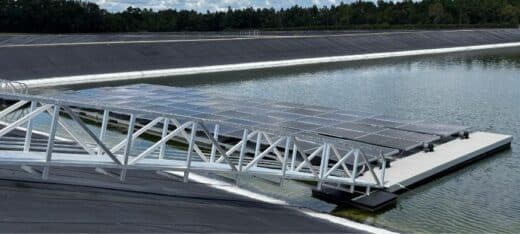
A floating solar installation must remain accessible throughout its operating life. That means project planning should account for more than panel placement. Integrated walkways, access routes, shoreline connection points, electrical equipment, cable management, and maintenance areas all influence the final layout.
Technicians need safe and practical access for inspections, preventative maintenance, repairs, and component replacement. Designing the maximum possible panel coverage without considering long-term access can create unnecessary operational challenges. A strong floating solar array design balances energy generation with accessibility, durability, and long-term serviceability.
Consider Anchoring and Mooring Requirements
Anchoring and mooring are essential elements of floating solar projects and can influence how much of a water body is practically usable. The appropriate approach depends on factors such as water depth, water-level variation, wind conditions, bottom composition, array size, shoreline characteristics, and overall system design.
Space may be required around the array to accommodate mooring lines and expected system movement. These considerations become especially important on larger projects where environmental loads can be significant. A system must be engineered for the conditions it is expected to experience throughout its service life, rather than simply designed to maximize the number of panels on the water.
Electrical Infrastructure Can Influence System Capacity
Physical space is only one side of the sizing equation. A water body may have enough surface area for a large floating solar installation, but the surrounding electrical infrastructure must also be capable of supporting the project.
Developers need to consider factors such as proximity to interconnection infrastructure, available grid capacity, voltage requirements, inverter placement, cable routing, transformers, and potential upgrade requirements.
For front-of-the-meter projects, the available interconnection capacity may ultimately limit project size even if significantly more solar could physically fit on the water. This reinforces the importance of considering more than physical space, as the largest possible system is not always the most viable system.
Regulations and Permitting Matter
Requirements for floating solar vary by location. Local authorities, state agencies, utilities, environmental regulators, and other stakeholders may establish requirements affecting water coverage, setbacks, environmental reviews, electrical infrastructure, or overall project capacity.
Community solar rules can also vary from state to state, and program requirements can evolve over time. Developers should confirm current regulations and program rules rather than assuming that a project structure that works in one state will apply in another. Early regulatory research can prevent a project from being sized around assumptions that later need to be changed.
Understanding Your Site’s Floating Solar Potential
Successful floating solar development is not about covering as much water as possible. It is about finding the right relationship between energy demand, available water surface, project economics, electrical infrastructure, regulations, and long-term system performance.
For behind-the-meter projects, electricity consumption may be the primary driver. For community solar and other front-of-the-meter projects, program capacity limits and available water area may have greater influence. For utility-scale installations, large water bodies and suitable interconnection opportunities become increasingly important.
A simple two-acre-per-megawatt guideline can provide a valuable first look at project potential, but detailed site conditions ultimately determine what is feasible.
AccuSolar designs and manufactures floating solar systems for a range of water bodies and project applications. By evaluating site geometry, project capacity goals, water conditions, access, and long-term operational requirements, our team can help determine an appropriate path from initial concept to project development.
Have a pond, reservoir, or other man-made water body you are considering for floating solar? Contact us to discuss your site and determine what size floating solar system could be a fit for your project.