In today’s energy landscape, businesses are not just dealing with rising electricity costs, they are navigating a complex mix of peak demand penalties, volatile pricing structures, and increasing grid instability. Among these challenges, demand charges remain one of the most misunderstood and most expensive components of a commercial energy bill.
For many facilities, demand charges can account for 30–70% of total electricity costs. Unlike standard energy usage charges, they are driven by short bursts of peak consumption, rather than total energy use. So how can businesses take control?
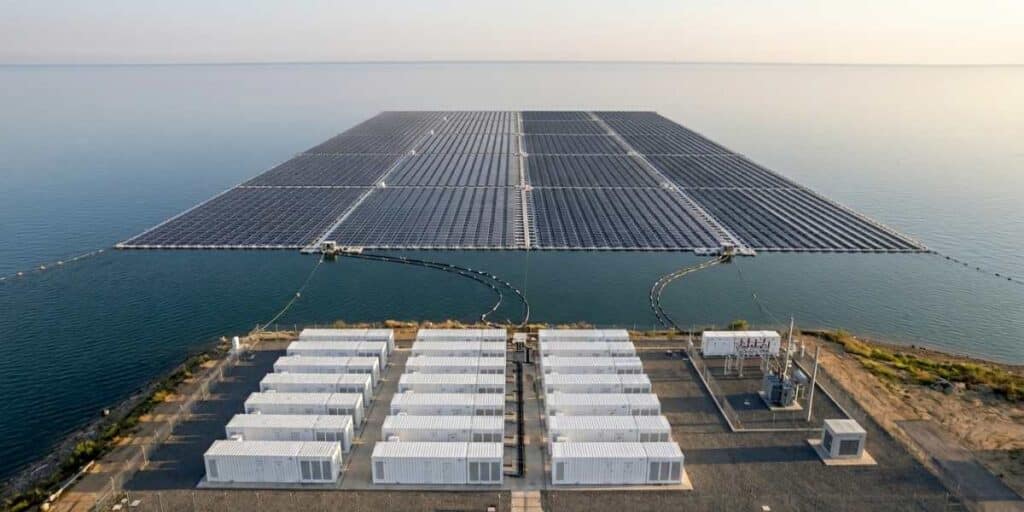
The answer isn’t a single technology it’s a strategic combination. When Floating Photovoltaics (FPV) are paired with storage, facilities can fundamentally reshape how they generate, store, and deploy energy. Done right, this approach can reliably reduce demand charges while improving resilience and long-term financial performance.
Understanding Demand Charges
Demand charges are based on your facility’s highest level of power consumption during a billing cycle, typically measured in 15-minute intervals. Even a brief spike caused by equipment startup, HVAC surges, or overlapping loads can set your peak demand for the entire month. That means one poorly timed surge can significantly inflate your bill.
Traditional solar helps offset total energy consumption, but it doesn’t always address these short-duration peaks. This is where storage becomes essential.
How Storage Helps Reduce Demand Charges
A battery energy storage system acts as a buffer between your facility and the grid. It stores excess energy when demand is low and discharges it when demand spikes.
This process commonly known as peak shaving is one of the most effective strategies to reduce demand charges. However, storage performance is entirely dependent on one critical factor: the quality of the energy feeding it. If your generation is inconsistent, poorly timed, or underperforming, your battery may not be fully charged when peak demand hits. When that happens, the value of your storage system drops dramatically. That’s why generation quality matters just as much as storage capacity.
Why FPV Changes the Equation
Floating solar introduces a major advantage into this equation: higher and more reliable energy production.
Unlike traditional ground-mounted systems, FPV installations operate in a more controlled optimized environment. The result is a system that doesn’t just generate power, but generates it more efficiently, consistently, and predictably.
Higher energy yield = better BESS utilization.
When your solar array produces more energy consistently, your storage system has greater opportunities to charge fully and discharge strategically. This is exactly what you need to reduce demand charges in a meaningful, repeatable way.
The FPV Advantage: Why It Works Better With Storage
Floating solar isn’t just a different installation method, it’s a performance upgrade. These systems are designed to maximize energy yield and reliability, which are critical for effective storage performance.
1. Extra Albedo Effect → More Generation Per Acre
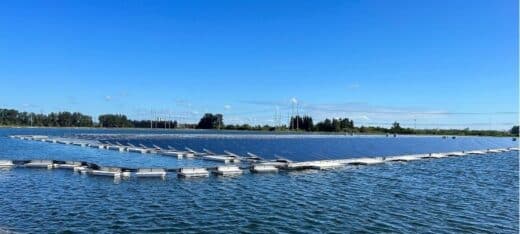
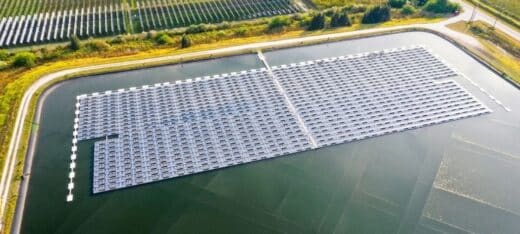
Water reflects sunlight, creating an additional albedo effect that increases irradiance on the backside of bifacial panels. This leads to higher energy output per acre compared to traditional systems. More generation means more energy available to charge storage and more flexibility in how that energy is used.
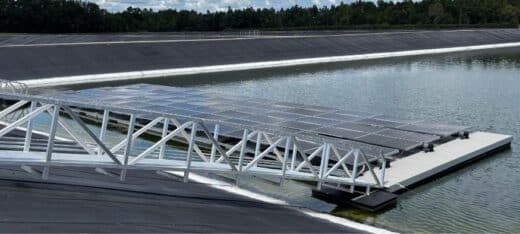
At AccuSolar, this advantage is further enhanced through the use of high-albedo white floats, which maxamize reflected light and backside panel exposure. With approximately 55% of the system’s surface area designed for reflectivity, this results in stronger, more consistent energy production.
2. Cooling From Water and Elevation → Higher Efficiency
Heat is a primary enemy of solar performance. FPV systems benefit from the natural cooling effect of the water below, along with increased airflow due to elevation. This keeps panel temperatures lower, especially in hot climates, allowing systems to maintain higher efficiency during peak sunlight hours when demand is often highest.
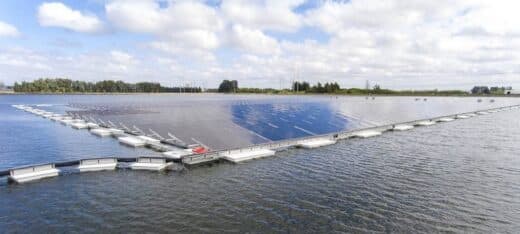
AccuSolar floating solar systems are engineered with optimized spacing between floats to promote airflow and enhance backside cooling. With roughly 30% open water integrated into the design, this approach significantly improves thermal performance while maintaining structural integrity.
3. More Predictable Generation Curves
Consistency is critical when integrating solar with storage. FPV systems tend to produce smoother, more predictable generation profiles due to their stable environmental conditions. This predictability allows storage systems to charge and discharge with greater precision, improving overall system reliability.
4. Seasonal Tilt Adjustments → Alignment With Peak Demand
FPV systems can be designed with adjustable tilt angles, allowing operators to optimize panel positioning throughout the year. This ensures that generation can be aligned more closely with seasonal demand patterns such as late afternoon peaks in summer ensuring energy is available exactly when it’s needed most.
5. Stronger Structural Reliability
FPV systems are engineered with fewer, stronger anchor points, reducing movement and improving structural stability. Less movement means fewer disruptions in production, resulting in a more consistent and dependable energy supply.
6. Stable Production Feeding Storage
Because FPV systems are inherently more stable, they provide a steady and reliable energy input into storage. This stability ensures your system is consistently charged and ready to respond during peak demand events exactly when it matters most.
FPV and Storage as an Integrated Energy System
It’s easy to think of solar and storage as separate technologies working side-by-side but their value comes from how they interact. A high-performing FPV system improves how effectively storage operates, while storage maximizes the financial value of every kilowatt-hour generated.
Together, they create a continuous loop of optimization:
- More generation → better battery charging
- Better charging → more effective peak shaving
- More effective peak shaving → lower demand costs
This is where systems begin to truly reduce demand charges in a consistent, measurable way.
System Optimization as the Primary Driver of Storage ROI
FPV and storage only deliver maximum value when generation is optimized and reliable. If your solar system underperforms or produces energy inconsistently your storage system will not have the energy it needs to operate effectively. That leads to missed peak shaving opportunities, reduced savings, and longer payback periods.
Key Point: FPV + BESS works best if your generation is optimized and reliable otherwise storage ROI can collapse. It’s not just about installing solar and adding storage, it’s about ensuring both systems are engineered to work together seamlessly.
Operational and Financial Outcomes
When properly implemented, FPV + storage systems deliver tangible, real-world benefits:
- Peak Demand Reduction: Storage discharges during high-load intervals, lowering your recorded peak.
- Load Shifting: Excess solar energy is stored and used later, reducing reliance on grid power.
- Improved Resilience: Facilities gain backup power capabilities during outages.
- Optimized Asset Utilization: Every kWh generated is used strategically.
Most importantly, businesses gain control over one of the most volatile aspects of their energy bill. As energy costs continue to rise and grid conditions become more unpredictable, relying on a single solution is no longer enough. The combination of FPV and storage represents a smarter, more integrated approach.
The result is a system that doesn’t just offset energy usage, it actively works to reduce demand charges, stabilize operating costs, and maximize return on investment. Contact us to explore how you can reduce demand charges and improve your facility’s energy performance.