Water Treatment & Wastewater
“We spend a lot operating this facility, and there’s a pond right next to the electrical load.”
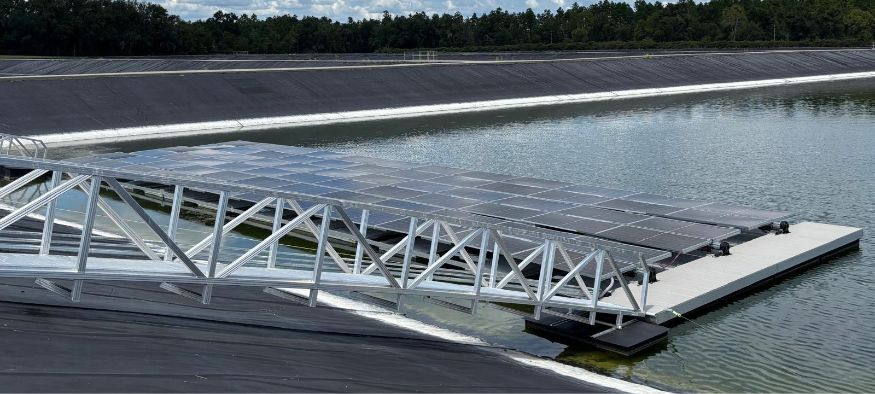
Floating Solar for Water Treatment & Wastewater Plants
Water and wastewater treatment facilities are among the most compelling applications for floating solar. Treatment operations can require significant and continuous electricity, while ponds, reservoirs, and other managed water bodies may provide available surface area for onsite renewable energy generation without competing for valuable land.
AccuSolar works with water utilities, municipalities, engineers, developers, and EPCs to evaluate and deploy floating photovoltaic (FPV) systems designed around the unique operational and environmental requirements of water and wastewater facilities.
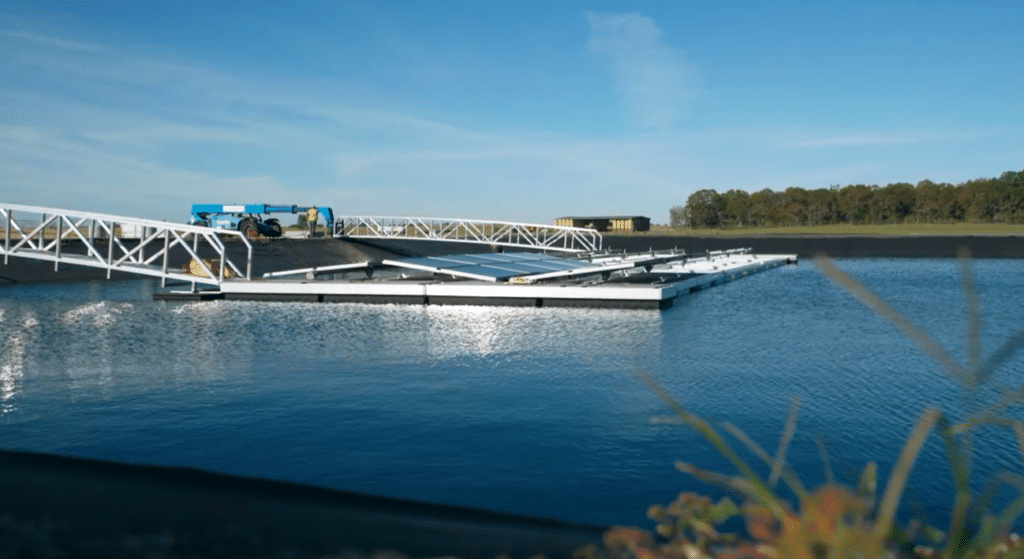
Why Floating Solar for Water & Wastewater?
Energy Generation Where the Demand Already Exists
Offset Facility Energy Demand: Pumps, aeration systems, treatment equipment, controls, and other processes can make water and wastewater treatment energy-intensive operations. Floating solar can provide renewable generation directly at or near the facility’s electrical load.
Preserve Valuable Land: Using existing water surfaces can reduce the amount of land required for solar development, allowing available property to remain accessible for treatment infrastructure, future expansion, operations, or other uses.
Put Existing Water Assets to Work: Treatment ponds, reservoirs, and other managed water bodies can provide an opportunity to generate energy from infrastructure already incorporated into the facility.
Support Energy & Sustainability Goals: FPV can become part of a broader energy strategy that may include onsite solar, energy storage, efficiency improvements, and other measures designed to reduce energy costs and increase energy resilience.
Support Energy Resilience and Long-Term Planning: Water and wastewater facilities provide essential public services and often operate continuously. FPV can become part of a broader facility energy strategy that may include solar, battery storage, efficiency improvements, backup generation, and other measures intended to manage energy costs and strengthen long-term energy planning.
Generate Energy Where Treatment Facilities Consume It
Behind the Meter Floating Solar
Pumps, aeration systems, blowers, filtration equipment, controls, disinfection systems, and other treatment processes can create substantial and relatively consistent electrical demand. When floating solar is installed on a pond or reservoir associated with the facility, renewable generation may be consumed directly behind the meter, offsetting a portion of the electricity otherwise purchased from the utility during solar-production hours.
Floating Solar + Battery Storage
Battery energy storage can be evaluated alongside floating solar where peak-demand management, load shifting, increased onsite solar utilization, or resilience for critical facility loads may provide additional value.
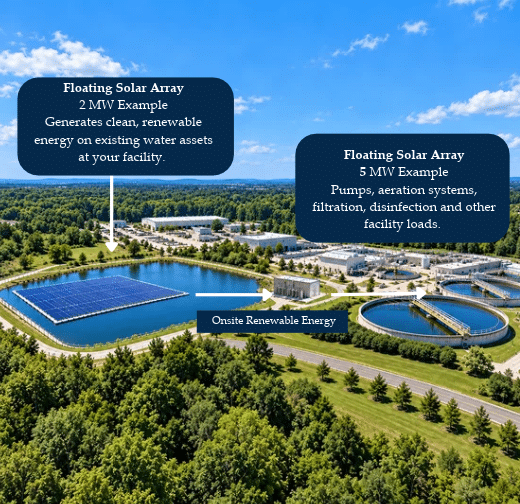
Designed Around an Operating Treatment Facility – Treatment Operations Come First
Water and wastewater ponds are operating infrastructure. They may support treatment processes, storage, aeration, equalization, discharge management, water supply, or other essential facility functions. Floating solar should be integrated around those responsibilities without compromising treatment performance, required access, or the facility’s ability to operate and maintain its systems.
AccuSolar works with the project team to understand how each water body functions within the treatment process and incorporate those requirements into the FPV layout, access system, anchoring, mooring, and electrical design.
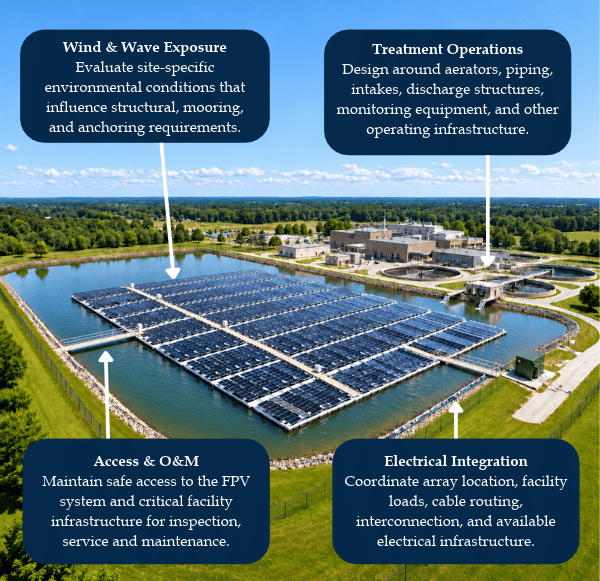
Floating solar cannot be approached as a one-size-fits-all system. Treatment processes, water levels, water chemistry, operating equipment, access requirements, environmental conditions, and available surface area can all influence FPV design. AccuSolar works with the project team to evaluate considerations including:
Treatment Processes & Equipment: Aerators, mixers, piping, pumps, intakes, discharge structures, monitoring equipment, sampling locations, and other treatment infrastructure must remain accessible and operational.
Water-Level Variation: Operating ranges, rainfall, treatment processes, storage requirements, discharge, and seasonal conditions may create changes in water elevation that must be accommodated by the FPV and mooring system.
Operational Access: Facility personnel must retain appropriate access to treatment equipment, shorelines, water-management infrastructure, and emergency response areas.
FPV Operations & Maintenance: Array layouts should provide practical access for module inspection, electrical service, cleaning, component replacement, and other long-term O&M activities.
Wind & Wave Exposure: Water-body size, fetch, shoreline conditions, water depth, and local environmental conditions influence structural, mooring, and anchoring requirements.
Electrical Integration: Facility load profile, existing electrical infrastructure, available points of connection, cable routing, voltage, and interconnection requirements influence system configuration
Designed with Water Quality in Mind – Materials Matter When Infrastructure Lives on Water
Floating solar equipment installed on treatment ponds, reservoirs, and other managed water bodies remains in continuous contact with the water environment for decades. Material selection, durability, water chemistry, and long-term degradation should therefore be considered as part of FPV system design.
AccuSolar uses marine-grade aluminum structures and durable foam-filled HDPE flotation selected for long-term deployment in water environments. Our foam-filled flotation is manufactured without PFAS and designed to maintain its structural integrity rather than relying on thin, hollow plastic flotation.
Potable-Water Applications: Materials suitable for potable-water applications are available for projects where specific water-contact requirements apply.
Water & Environmental Conditions
Floating solar changes the relationship between sunlight, wind, and the covered portion of a water surface. Depending on the water body and coverage ratio, FPV may influence evaporation, water temperature, algae growth, dissolved oxygen, and other water characteristics. These potential effects should be evaluated based on the function and environmental requirements of the individual facility rather than assumed to be universally beneficial.
Evaporation — Surface coverage may reduce water loss from evaporation.
Water Temperature — Shading may influence surface-water temperatures beneath and around the array.
Algae & Light Exposure — Reduced sunlight reaching portions of the water surface may influence conditions associated with biological growth.
Water Quality Monitoring — Treatment facilities may provide an opportunity to monitor actual water conditions before and after FPV deployment.
.
From Treatment Water Asset to Energy Asset
Not every treatment pond or reservoir will be appropriate for floating solar. Facility energy demand, water-body function, available surface area, treatment equipment, water conditions, electrical infrastructure, environmental requirements, and site conditions can all influence project viability. AccuSolar’s Project Readiness Evaluation (PRE) provides a structured process for evaluating these factors and determining whether a water or wastewater facility warrants further FPV development.
Questions to Consider When Evaluating a Water or Wastewater Facility
Facility Energy Demand: How much electricity does the facility consume, when is it consumed, and how does potential FPV generation align with the operating load profile?
Water Body Function: What role does the pond or reservoir serve within the treatment process?
Available Water Surface: How much usable surface area exists, and what portions must remain open for treatment operations, equipment, access, or environmental requirements?
Treatment Infrastructure: What aerators, mixers, pumps, piping, intakes, discharge structures, monitoring equipment, or other systems must remain accessible?
Water-Level Range: How does water elevation vary during normal operation, seasonal conditions, storm events, storage cycles, or discharge?
Water Conditions: What water chemistry, temperature, biological activity, or other characteristics should be considered in system design and material selection?
Site Conditions: What are the water depth, bathymetry, shoreline conditions, wind exposure, wave environment, and potential anchoring conditions?
Electrical Infrastructure: Where can FPV connect to the facility electrical system, and what equipment or upgrades may be required?
Preliminary System Size & Energy Offset: How much FPV capacity can reasonably fit the site, and what portion of facility electricity consumption could potentially be offset?
Energy Storage Opportunity: Could battery storage improve onsite solar utilization, reduce peak demand, support load shifting, or provide resilience for critical loads?
Operational & O&M Requirements: How will facility personnel and solar maintenance teams access their respective equipment throughout the project life?
Project Path: What engineering, permitting, environmental, interconnection, procurement, stakeholder, and budget considerations need to be addressed?
Built for Long-Term Operations – Designed for Decades on the Water
Water and wastewater infrastructure is built for long-term operation, and the floating solar platform supporting it should be as well. AccuSolar combines marine-grade aluminum structures, durable foam-filled HDPE floats, stainless steel hardware, and serviceable components to create a floating platform designed around long-term reliability.
25-Year Warranty
AccuSolar backs its primary aluminum structures and foam-filled floats with a 25-year warranty, providing long-term confidence in the components supporting the solar array.
Durable, Foam-Filled Floats: Our heavy-duty HDPE floats are filled with closed-cell foam, providing redundant buoyancy even if the exterior shell is damaged. This construction significantly reduces the likelihood that floats will require replacement over the life of the project.
Built for Serviceability: Integrated walkways and stable access areas support routine inspections, electrical service, module replacement, and other O&M activities without requiring specialized access across the array.
Lower Lifecycle Replacement Exposure: Durable materials, foam-filled flotation, and individually serviceable components are designed to minimize major platform replacement requirements and the associated costs and disruption over the operating life of the system.
U.S. Manufactured Floating Solar
AccuSolar manufactures its primary structural frames and foam-filled HDPE floats at our 67,000-square-foot manufacturing facility in Pompano Beach, Florida. In-house U.S. manufacturing provides direct oversight of production, QA/QC, documentation, packing, and shipment while allowing our engineering and manufacturing teams to work together as project requirements evolve.
Water & Wastewater Floating Solar Projects
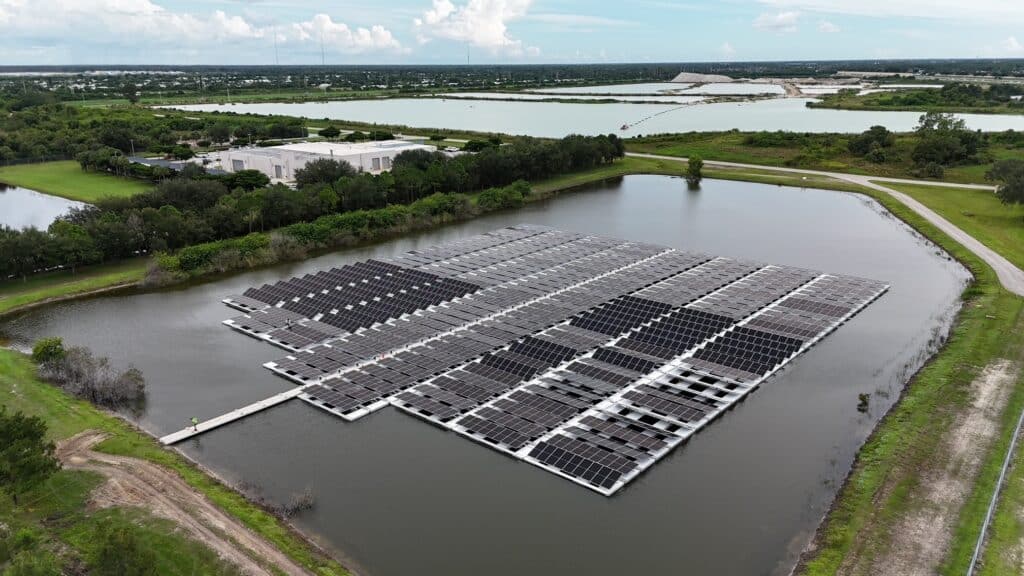
Bonita Springs Utilities East Water Reclamation Facility – 1.5 MW AC
Explore Floating Solar for Your Facility
Whether you’re evaluating a wastewater treatment pond, water reservoir, or other managed water body, AccuSolar can help determine whether floating solar is appropriate for the site and what information is needed to move the project forward.
Your Trusted Partner
With over two decades of experience, AccuSolar specializes in designing and engineering innovative floating solar systems tailored to your unique needs. Our solutions are built to withstand the harshest conditions, ensuring optimal performance and reliability.
By partnering with AccuSolar, you’re choosing a proven leader in floating solar technology. Our commitment to excellence ensures that your investment in renewable energy is both rewarding and sustainable.