As water scarcity intensifies across the United States and around the world, municipalities, utilities, and agricultural water districts are being pushed to protect every available drop. Rising temperatures, prolonged drought cycles, and growing population demands are accelerating evaporation from reservoirs, irrigation ponds, and retention basins at unprecedented rates.
At the same time, pressure is mounting to expand clean energy infrastructure. What is often overlooked is that floating solar solves both challenges at once.
While solar is typically evaluated through the lens of megawatts. Saving on electrical expenses, and carbon reduction, floating solar delivers another powerful benefit that is reshaping infrastructure planning, it protects water resources.
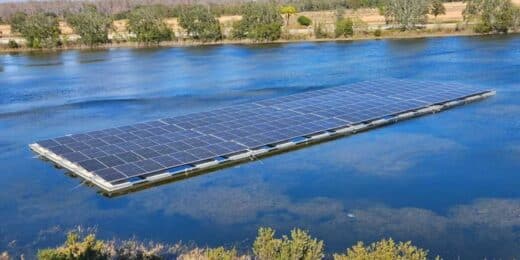
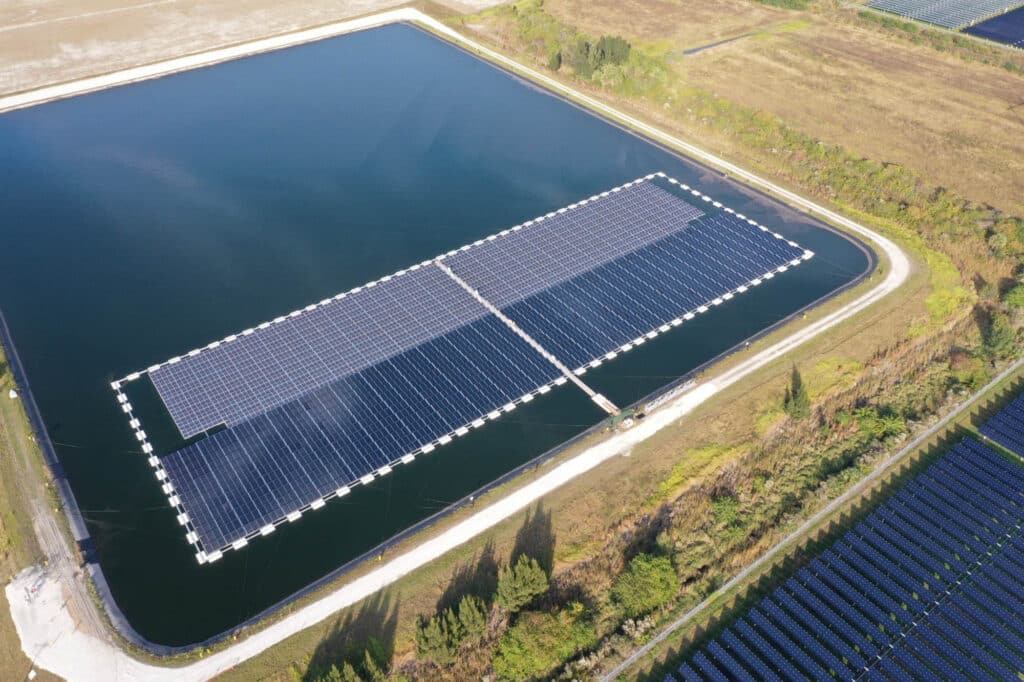
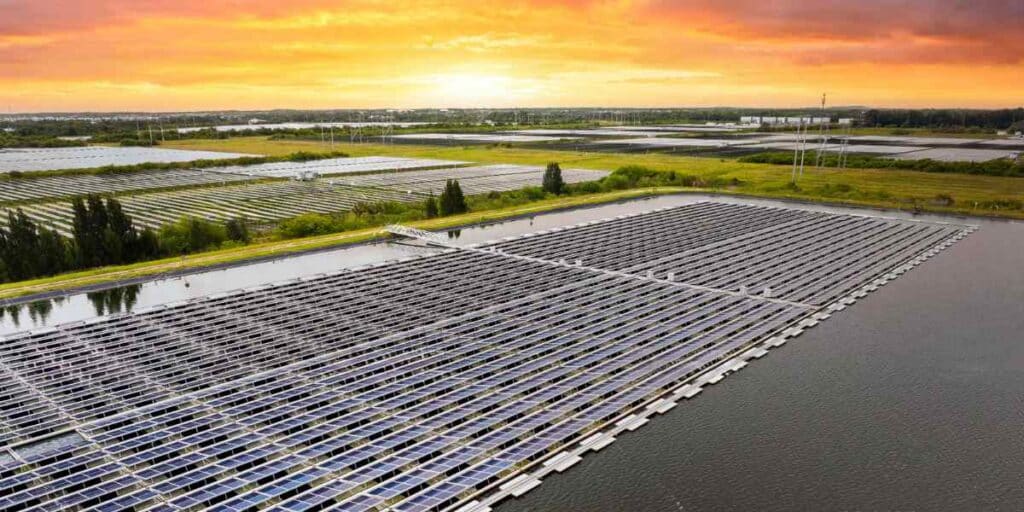
Floating solar systems do more than generate clean electricity. By shading the water surface, they slow evaporation at its source reflecting and absorbing the sunlight that heats the water surface. This evaporation loss prevention helps water managers retain millions of gallons each year while transforming underutilized water bodies into productive energy assets. This model is changing how projects are evaluated. The conversation is no longer only about energy output, it is about water-saving ROI and adopting modern reservoir evaporation control methods to protect this precious asset when and where it is most needed.
The Hidden Cost of Evaporation
Evaporation is one of the largest yet least visible sources of water loss. In warm climates, reservoirs can lose several feet of water annually. For agricultural districts, that loss reduces irrigation capacity and increases dependence on unpredictable rainfall. For municipalities, it strains drinking water supplies and forces difficult operational tradeoffs.
Replacing lost water is rarely simple or inexpensive. Pumping, treating, and transporting replacement supplies requires substantial infrastructure investment and ongoing energy use. In drought-prone regions, additional water may not be available at all.
Floating solar changes this equation. By blocking direct sunlight from reaching the water surface, thermal gain is reduced and the evaporation cycle slows. The greater the shading coverage and continuity, the stronger the conservation impact. For water authorities balancing near-term budgets with long-term resilience planning, this creates measurable and durable economic value.
Quantifying the Water-Saving ROI
The financial case for evaporation loss prevention is becoming increasingly compelling. Research shows that floating solar installations can significantly reduce evaporation depending on climate conditions, system design, and surface coverage.
Consider a mid-sized reservoir serving an agricultural region. If that reservoir loses billions of gallons annually to evaporation, even a modest reduction can preserve enough water to irrigate thousands of acres. The avoided cost of sourcing replacement water, combined with improved supply reliability, quickly adds up.
Municipal utilities see similar advantages. Retained water reduces treatment demand, lowers pumping requirements, and helps defer expensive infrastructure expansions. In many cases, operational savings alone strengthen the business case for floating solar before electricity generation is even considered. When power production is added, the project evolves from a conservation measure into a revenue-generating asset.
That is why forward-thinking water managers increasingly view floating solar not merely as an energy project placed on water, but as a water management strategy that also produces power.
We are collaborating with a leading academic institution to quantify the water conservation benefits of specific sustainable technologies. This data collection is the final phase in validating a first-of-its-kind program that provides insurable water credits for measurable conservation efforts.
Success in this area represents a major milestone for the renewable energy sector. By verifying the reduction in water loss, we unlock the potential for significant financial incentives. These credits offer a new pathway for global corporations to meet ambitious sustainability targets through high-impact, cost-effective environmental offsets. In fact, the financial value of these water savings has the potential to exceed the traditional revenue generated by the energy production itself.
Why Architecture Matters for Evaporation Loss Prevention
Not all floating solar systems deliver the same level of water protection. Evaporation performance is heavily influenced by platform design, array geometry, and the percentage of surface coverage that can realistically be achieved.
Systems originally engineered solely for energy production often treat shading as a secondary outcome. By contrast, infrastructure designed with evaporation loss prevention in mind allows project teams to intentionally optimize for evaporation mitigation.
Our floating solar architecture enables projects to prioritize water preservation without sacrificing structural integrity or long-term performance.
Maximum Shading Flexibility: Our racking system supports very low tilt angles, including configurations approaching zero degrees. This allows developers to prioritize maximum surface shading when evaporation reduction is the primary objective.
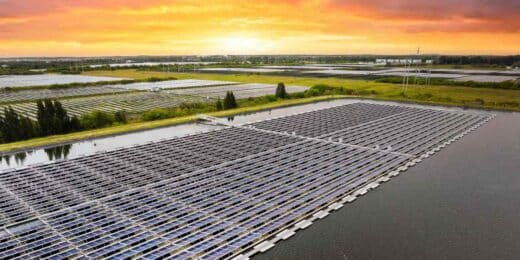
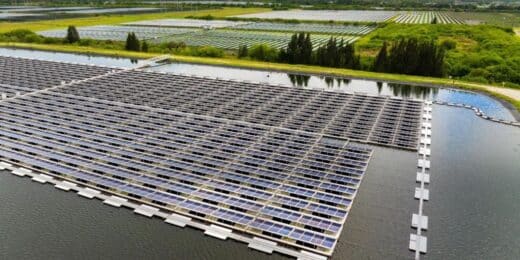
Higher Contiguous Water Coverage: A robust floating platform and anchoring system make it possible to construct larger, more continuous solar fields. Fragmented layouts leave exposed channels where sunlight can penetrate larger contiguous arrays eliminate these vulnerabilities.
Minimal Gaps Reduce Sunlight Hot Spots: Tighter spacing between rows minimizes windows that act as localized heating zones. This supports uniform temperature conditions across the water body.
More Panels Per Acre: Higher structural load capacity allows for increased panel density. Greater areal coverage translates directly into expanded shading and higher power density.
Cooler Panel Operation Over Water: Floating solar naturally benefits from the water’s cooling effect. Our systems allow airflow beneath the arrays while maintaining thermal advantages. Cooler panels perform more efficiently and transfer less heat to the water below, further minimizing evaporation.
A Strategic Asset for Water Managers
Floating solar is redefining what infrastructure can accomplish. Instead of dedicating valuable land to energy projects, organizations can activate existing water surfaces while safeguarding one of their most critical resources.
For agricultural operators, this means improved irrigation certainty and better crop planning. For municipalities, it strengthens long-term supply stability and drought preparedness. For utilities, it aligns conservation goals with decarbonization efforts.
The return on investment extends far beyond electricity. It delivers energy resilience, water security, and operational savings.
As demand for clean energy and reliable water supplies continues to rise, solutions that address both challenges simultaneously will shape the future of infrastructure. Floating solar sits at that intersection. By combining advanced engineering with intentional conservation design, we prove that the surface of a reservoir can do far more than store water. It can protect it.
If your organization is exploring ways to reduce evaporation losses while generating clean energy, our team is ready to help you quantify the water-saving ROI and design a system tailored to your conservation goals. Contact us to start the conversation and discover how floating solar can protect your water assets while powering your future.