Climate change isn’t just a story about smokestacks and carbon dioxide. It’s also about sunlight and how much of it we bounce back into space versus how much we soak up. Understanding what is the albedo effect helps us see why this matters. Picture Earth like a giant stage: every ray of sunshine is a spotlight, and what happens next depends on whether the surface acts like a mirror or a sponge.
Now here’s the twist. Scientists and innovators have found a way to flip the script using water itself. Floating solar panels aren’t just power producers gliding on lakes and reservoirs; they’re like clever shields that help manage how sunlight interacts with our planet. They generate clean energy and give Earth a bit of cooling relief at the same time.
Ever heard of the albedo effect? Don’t worry, we’ll break down this complex climate science into simple, intuitive language using easy analogies. Then, we’ll dive into an exciting solution: floating solar panels. Learn exactly how they offer a genuine climate benefit, exploring their advantages, obstacles, and what the future holds for this innovative technology.
Defining the Albedo Effect
Imagine you’re standing outside on a hot summer day. If you’re wearing a white T-shirt, you feel cooler. If you’re wearing a black one, you heat up much more. Why? Because white reflects much of the sunlight, black absorbs most of it.
That choice of shirt is an analogy for how the Earth’s surface behaves. The albedo effect refers to how much sunlight (solar energy) a surface reflects back into space versus how much it absorbs.
High albedo surfaces—ice, snow, clouds, light-colored sand—act like bright mirrors, bouncing sunlight away and keeping temperatures cooler.
Low albedo surfaces—oceans, asphalt, forests, and dark soil—act like sponges, soaking up sunlight and turning it into heat.
In simple terms:
- High albedo = more reflection = cooling effect
- Low albedo = more absorption = warming effect
Asking “What is the albedo effect?” is the same as asking: How does the balance between Earth’s heat-reflecting “mirrors” and heat-absorbing “sponges” determine our planet’s climate?
Why Albedo Matters for Climate
The albedo effect isn’t just a physics trivia fact. It’s one of the reasons our climate can spiral into warming faster than expected.
Think of Earth as both a mirror and a sponge:
- The mirror parts (ice sheets, glaciers, snowfields) reflect solar energy, keeping the system cool.
- The sponge parts (oceans, bare ground, dark surfaces) soak up energy, locking in heat.
Here’s the problem. As global temperatures rise, the mirrors start to shrink. Ice melts, exposing darker water or land underneath. Suddenly, more sunlight is absorbed instead of reflected. That accelerates warming, which melts even more ice—a self-reinforcing cycle scientists call a positive feedback loop.
Losing reflective surfaces doesn’t just warm the globe; it changes local environments too. Melting Arctic sea ice disrupts weather patterns worldwide. Shrinking snowpack alters water supplies in mountain regions. Even at smaller scales, such as urban neighborhoods, replacing light surfaces with dark roofs or asphalt creates “heat islands” that trap warmth.
This is why boosting reflective surfaces or at least reducing how much heat-absorbing surface area we expose matters. And it’s where floating solar starts to play an unexpected role.
How Floating Solar Panels Improve the Albedo Balance
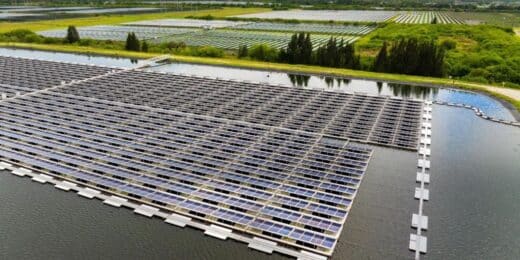
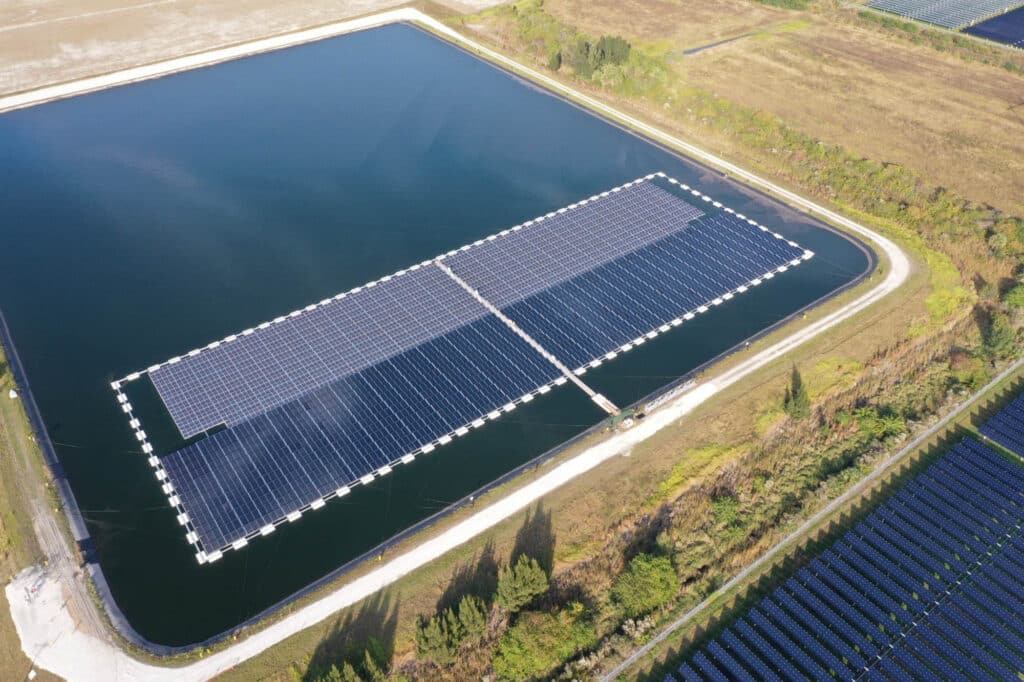
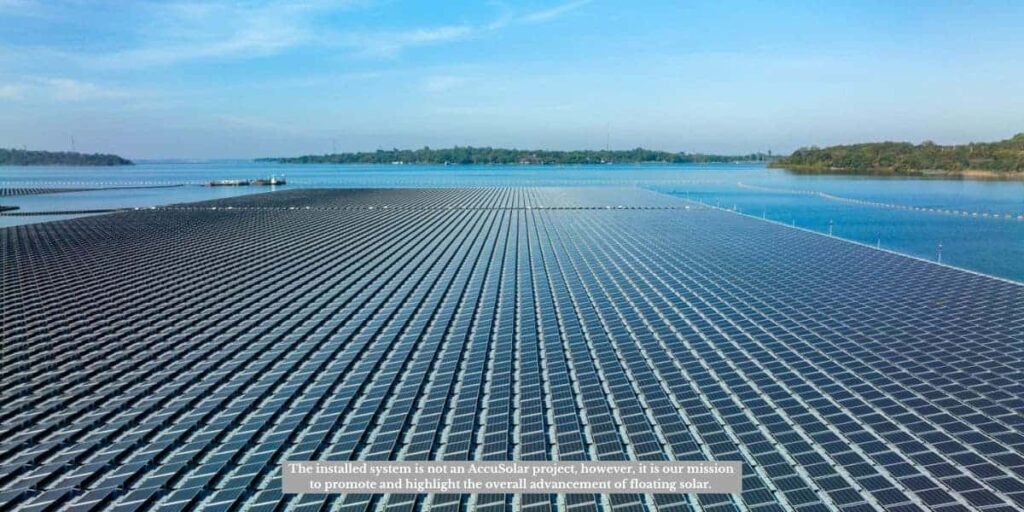
The innovative solution of floating solar panels does more than just generate clean energy; it actively alters the albedo of the water surfaces they cover, shifting the balance from absorption back toward reflection.
Think of a typical reservoir or lake. The water’s surface, especially on a calm, sunny day, is a very efficient solar energy absorber. It has a low albedo, soaking up the sun’s rays and converting that energy into heat, which warms the water and the surrounding air.
This dual-action approach positions floating solar as a transformative renewable technology that addresses both energy production and climate mitigation simultaneously.
When we install a floating solar array, it acts as a two-part solution:
Part One: The Shade
The panels create a large, continuous canopy that provides shade to the water below. By blocking direct sunlight from reaching the water’s surface, the panels prevent the water from absorbing that solar energy and heating up. This is similar to how a large shade tree cools the ground beneath it.
Part Two: The Reflective Surface
While solar panels are designed to absorb sunlight to generate electricity, their glass surfaces are also more reflective than water. The albedo of a typical solar panel is around 0.2 to 0.3. While this is not as high as snow, it’s still significantly higher than the albedo of water, which can be as low as 0.06 in deep, dark conditions. This means a portion of the incoming sunlight is reflected away, and the rest is converted into useful electricity, not into absorbed heat.
This dual action—shading the water and providing a more reflective surface—achieves a net-positive climate effect. It not only reduces the overall heat absorbed by the water body but also helps to moderate local temperatures, creating a cooler microclimate. The effects are tangible: reduced water evaporation, less heat stress on aquatic life, and a more efficient energy production process because the panels themselves are cooled by the water they float on.
How Floating Solar Panels Enhance Albedo and Offer Key Benefits
Floating solar panel installations significantly impact the interaction of sunlight with water, subtly shifting the balance from absorption toward reflection.
Direct Albedo Enhancement
Blocking Solar Absorption: Water is a low-albedo surface, absorbing a significant amount of solar radiation, which warms it up. By covering the water, the panels prevent direct sunlight from striking the surface, leading to less solar energy absorption by the body of water.
Surface Reflection: The panels themselves have a reflective surface that bounces a portion of the incoming sunlight back into the atmosphere. This reflection represents a higher albedo effect compared to the water’s natural absorption.
Water and Local Climate Moderation
Evaporation Reduction & Cooling: The shade and coverage from the panels slow down water evaporation and help keep the water underneath cooler. This thermal effect benefits aquatic ecosystems by reducing heat stress and discouraging harmful microbial or algae blooms.
Local Climate Moderation: Cooler water releases less latent and sensible heat into the air. This can lead to moderated air temperatures immediately surrounding the installation, offering a localized cooling effect that helps mitigate heat island effects in some areas.
Beyond climate benefits, floating solar systems can support agricultural water needs by reducing evaporation from irrigation reservoirs and maintaining cooler water temperatures for crops.
Improving Energy Efficiency
Enhanced Panel Performance: Unlike land-based installations where panels can overheat, the proximity to the cooler water helps to regulate the floating panels’ temperature. Cooler photovoltaic cells operate more efficiently, meaning the system generates a higher amount of electricity per installed capacity.
In essence, floatovoltaics are a dual-purpose technology efficiently generating renewable energy while simultaneously shifting the local environment’s thermal dynamics to favor reflection and cooling.
So, floating solar is not just about harnessing sunlight; it shifts how sunlight interacts with water and surroundings. It tilts the mirror-vs-sponge balance slightly more toward reflection and less toward absorption.
Understanding How Floating Solar Systems Work
To make this more intuitive, picture a house with three components:
The roof: when it’s dark (say black shingles), it absorbs nearly all the sun’s heat. The attic and rooms underneath get very hot.
Add a white reflective coating or a metal cover: this makes the roof reflect a lot of sunlight—cooler roof, cooler house.
Now imagine placing a large umbrella over part of the roof: shading part of it. That shaded area doesn’t get direct sun, thus stays cooler.
Map that to floating solar:
- The water surface is like the dark roof: absorbing solar energy.
- The floating panels are like a shading umbrella and reflective patch placed over parts of the roof. They reduce direct heating, reflect some sunlight, and moderate the environment underneath.
- The result: less absorbed heat, cooler “roof,” cooler house—in our case, water and the air above it.
What Is the Albedo Effect Exactly—and Where Floating Solar Fits In
The albedo effect is simply the balance between the solar energy Earth’s surfaces reflect and the energy they absorb, which dictates how much the planet warms.
When highly reflective surfaces like ice and snow are lost, darker surfaces like water and soil absorb more heat. In contrast, floating solar panels can introduce a reflective barrier that helps reduce local water heating.
This loss of natural reflectivity creates a positive feedback loop—warmer temperatures melt more ice and snow, exposing dark surfaces, which absorb more heat, leading to even warmer temperatures. This cycle accelerates warming globally. This means that any man-made intervention that adds reflective surface area, such as floating solar arrays on reservoirs, essentially works against this loop on a smaller, localized scale by blocking incoming radiation that would otherwise heat the water and contribute to overall thermal energy absorption.
Floating Solar and High Albedo: Understanding the Connection
When discussing floating solar, the term high albedo refers to surfaces that reflect a greater share of sunlight instead of absorbing it as heat. In this context, floating solar arrays increase the effective albedo of water bodies by shading and reflecting sunlight, helping moderate local temperatures while producing clean energy.
Water alone tends to have a low albedo; it absorbs a lot of sunlight, especially when the sun is high in the sky and the surface is smooth.
When floating solar panels cover water, two things happen: (1) some sunlight is blocked from entering the water, (2) some sunlight is reflected off the panel surfaces. Those reflected portions add to Earth’s reflective capacity—they are higher reflectivity relative to the water underneath.
Floating solar doesn’t make surfaces as reflective as pure snow or ice, but compared to water, it shifts the balance toward more reflection and less absorption. That shift helps in cooling, especially locally. Surfaces with high albedo properties play a key role in this temperature regulation process.
Potential Scale & Global Implications
To truly make a dent in global warming, floating solar power needs to be deployed at a scale that goes beyond simply producing clean energy—it must leverage its geophysical co-benefits. Here’s why scale matters for this technology:
Global Heat Reduction: Widespread deployment across reservoirs, lakes, and even suitable coastal or inland water bodies could result in massive, cumulative shading and partial reflection of sunlight. This would significantly reduce the planet’s overall heat absorption, offering a direct, non-power-generation benefit.
A Portfolio Climate Solution: While floating solar cannot replace the albedo (reflectivity) lost by melting snow and ice, it’s a powerful tool within a broader climate mitigation strategy. It complements other solutions like reforestation, urban planning (lighter roofs and reflective pavements), and reflective surface technologies.
Policy & Incentives: Accelerated adoption will hinge on smart policy. Governments and agencies should implement subsidies or regulations that specifically reward solar installations offering measurable climate co-benefits—such as increased albedo, reduced water evaporation, and positive ecosystem impacts.
Widespread deployment represents a critical climate adaptation strategy that complements reforestation, urban planning, and other reflective surface technologies in the fight against global warming.
Floating Solar Panels as a Climate Solution
Here are the key takeaways:
Understanding what is the albedo effect describes how much of the sun’s energy Earth’s surfaces reflect versus absorb. Highly reflective surfaces, like snow and ice, bounce back more sunlight, which has a cooling effect on the planet.
Water bodies typically exhibit low reflectivity, meaning they absorb most sunlight. This absorption drives processes like warming and evaporation.
Acting as both a shade and a reflective surface, floating solar panels on water block and reflect sunlight, significantly reducing heat absorption in the water and surroundings.
The advantages of floating solar extend past merely cooling water; this technology delivers clean energy production, substantial evaporation reduction, improved water quality, ecological benefits for wildlife, and the potential for localized air temperature moderation.
While trade-offs like costs, environmental impacts, and maintenance exist, well-designed floating solar installations can mitigate many of these risks.
The fight against climate change demands smart, multi-functional solutions. While cutting emissions and adopting renewables are crucial, floating solar panels offer a unique, dual advantage.
These systems do more than just produce clean energy; they actively contribute to climate resilience. They shade water to reduce heat absorption, create surfaces with high albedo characteristics, and cut evaporation losses. This makes them a powerful complement to all other environmental strategies.
Floating solar is rapidly moving from niche technology to a widespread climate tool—delivering power, localized cooling, water security, and ecosystem benefits. When you’re ready to explore what is the albedo effect in action through floating solar technology, AccuSolar can customize a dual-action floating solar solution for your site.
Contact us to start your project.
This article was originally published on June 6, 2024 and has been updated on October 16, 2025 to provide the most accurate and relevant information.