Floating solar has increasingly been pulled into the broader renewable energy conversation. That conversation is often loud, polarized, and ideological. Unfortunately, once infrastructure decisions turn into political statements, the quality of those decisions usually declines.
At AccuSolar, we take a different approach. Floating solar is not a belief system. It is not a position to defend. It is a tool and like any tool, it should be evaluated based on where it works, where it doesn’t, and what the data actually supports.
When Infrastructure Becomes Ideological, Practicality Suffers
Water bodies are not abstract concepts. Reservoirs, treatment basins, industrial ponds, and process lakes exist for very specific operational reasons. They are engineered assets with defined constraints, ownership structures, and long-term responsibilities.
Yet proposals involving water and energy are increasingly framed in political terms rather than technical ones. That framing doesn’t help utilities, municipalities, or industrial owners who are trying to make conservative, defensible decisions about capital deployment.
Those stakeholders are not asking whether floating solar aligns with a narrative. They are asking:
- Will this system perform under known conditions?
- What risks am I assuming over 20 to 30 years?
- How does this affect operations, maintenance, and liability?
- Does this create new constraints or reduce existing ones?
These questions are answered with engineering and data, not ideology.
Reducing Constraints, Not Replacing Land
One of the most practical reasons floating solar exists has nothing to do with politics and everything to do with land.
Usable land is finite and increasingly contested. Ground-mounted solar often competes directly with agriculture, industrial expansion, housing, conservation, or future utility use. Even when land-based projects are technically sound, land use alone can introduce friction, permitting risk, and long-term inflexibility.
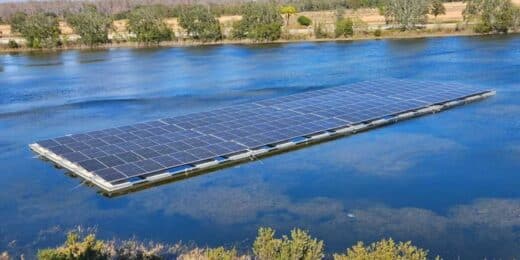
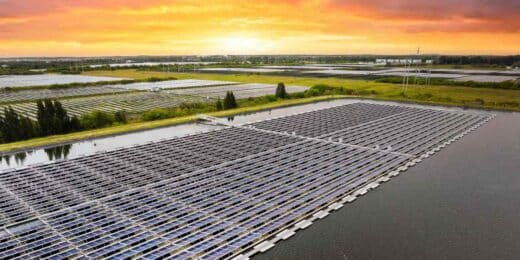
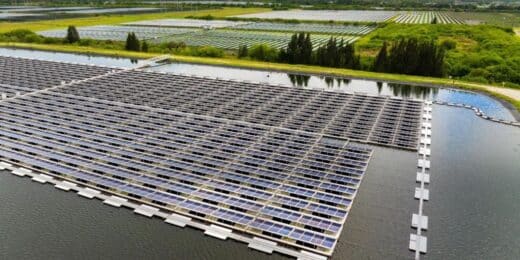
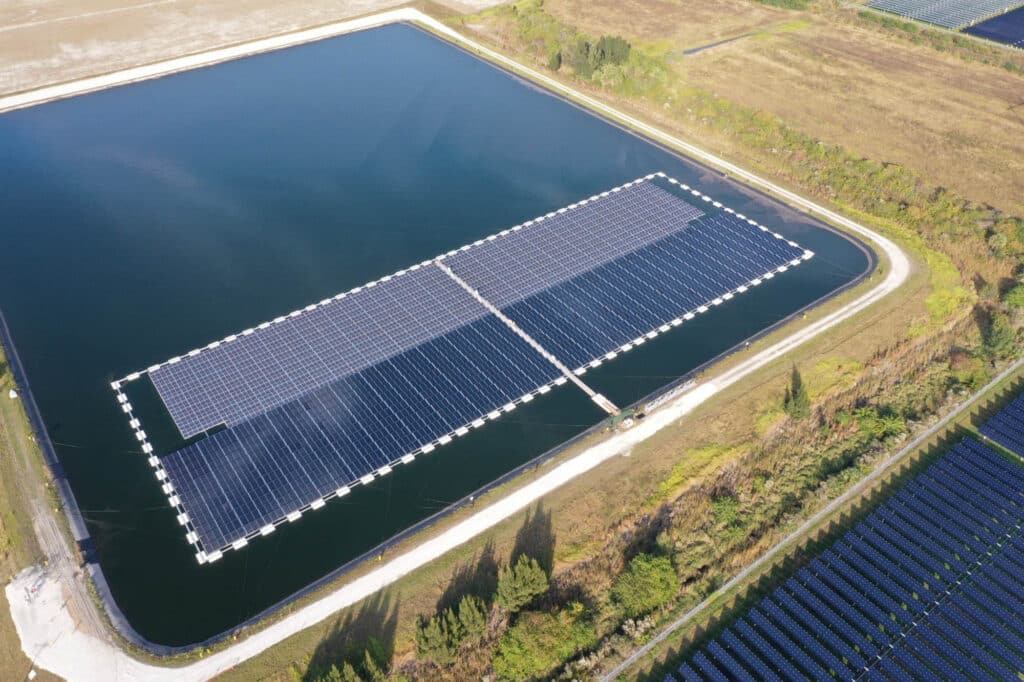
Floating solar approaches the problem differently by utilizing existing, non-recreational water bodies that were never intended for public use or redevelopment. In practice, most viable floating solar installations are deployed on:
- Water treatment plant basins
- Industrial process ponds
- Irrigation reservoirs
- Mining and quarry lakes
- Utility-owned reservoirs with restricted access
These are managed infrastructure assets with controlled access, known operating ranges, and long-term ownership stability. Floating solar does not displace recreation or compete with public land use, it operates within systems that already exist for operational purposes. Often, floating solar is chosen not to replace land-based solar, but to avoid land-use conflict altogether.
Solving Expensive Problems
AccuSolar did not enter floating solar solely because of clean energy initiatives or environmental narratives. We entered this space because we saw recurring operational and financial constraints that traditional solar development could not solve.
- Industrial and utility clients face:
- Rising energy costs
- Limited available land
- Increasing permitting complexity
- Underutilized water assets that still require maintenance and liability oversight
When properly engineered, floating solar addresses these constraints to produce measurable financial benefits. It can:
- Avoid land acquisition or land opportunity costs
- Reduce permitting friction tied to new land development
- Improve the productivity of existing water assets
- Accelerate development timelines in constrained environments
Every project must ultimately stand on its own financially. If the economics do not work, the project does not move forward—regardless of how well it fits a broader narrative. We are not deploying floating solar to make a statement; we are deploying it to improve capital efficiency.
Pairing Proven Technologies
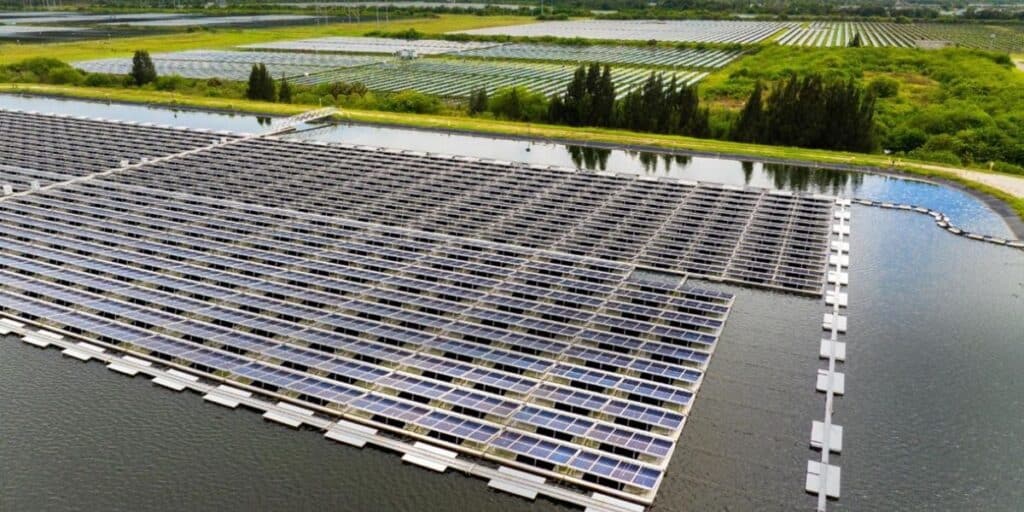
Floating solar is sometimes described as “new” or “experimental.” From an engineering standpoint, that’s misleading. At AccuSolar, floating solar is the deliberate pairing of two well-established technologies:
- Floating platform systems refined through nearly two decades of real-world marine and industrial deployment through our sister company AccuDock.
- Commercial solar technology with well-understood electrical, mechanical, and performance characteristics.
Floating docks have long supported variable loads, dynamic water conditions, and long service lives across marinas, utilities, and industrial facilities. Solar modules, inverters, and balance-of-system components are equally mature when properly designed and installed. Floating solar is not a technological gamble, but an integration challenge—one that benefits from experience in anchoring, access systems, and lifecycle maintenance.
Leading with Measured Outcomes
Predictions are easy; field performance is not. Our focus is on understanding how floating solar systems behave under real conditions, including:
- Structural and mooring loads under known wind and wave events
- Actual thermal effects on module performance, not assumed ones
- Installation sequencing and labor efficiency
- Long-term access and maintenance implications
We are not trying to prove that floating solar is universally better. We are determining where it makes operational and economic sense. Turning down projects when the data doesn’t support deployment is part of treating floating solar as infrastructure rather than messaging.
A Practical Alternative
Land-based solar remains the right solution in many cases. Floating solar is not intended to replace rooftop, carport, or ground-mount systems. It exists as an alternative where land is constrained or better preserved for other uses.
When deployed correctly, floating solar reduces permitting friction and integrates cleanly into existing infrastructure. When deployed incorrectly, it becomes a liability. That is why site-specific analysis matters more than broad renewable initiatives. Beyond technical feasibility, each project must demonstrate a clear, defensible return on investment.
Infrastructure Should Be Quiet and Reliable
The best infrastructure projects don’t generate debate. They perform quietly, year after year, because they were designed for the environments they serve.
Floating solar succeeds when it is treated as a practical response to specific constraints, not a statement about energy policy. We prioritize data over politics because we expect floating solar’s long-term value to be proven in performance, not in arguments.
Contact AccuSolar to learn more about our floating solar systems and how our integration of proven marine and solar technologies can improve your capital efficiency.